This article contains affiliate links. If you book through them we may earn a small commission at no extra cost to you — it helps keep Authentic Japan free.
Five days sounds inadequate for Japan. The country spans 3,000 km, has 47 prefectures, and generates enough "must-see" content to fill an encyclopedia. But five days, focused correctly, is enough to feel Japan rather than merely photograph it. The key word is focused: two cities, not six.
This itinerary covers Tokyo for Days 1–2, a shinkansen transfer on Day 3, and Kyoto for Days 3–4, with departure on Day 5. That means Osaka, Hiroshima, Hakone, and Nara are deliberately out of scope. For a first trip, the Tokyo-Kyoto pair delivers the two sharpest contrasts Japan offers — a hypermodern megalopolis and a thousand-year imperial city — without the transit overhead that turns a short trip into a commute.
Day 1 — Arrive in Tokyo, Get Your Bearings
Land at Narita (NRT) or Haneda (HND). Your first task: pick up a Suica IC card at the airport station (top-up with cash; starts at ¥500 deposit). This single card pays for every train, subway, and bus you'll use in both cities, plus convenience stores and vending machines. The Narita Express (N'EX) runs to Shinjuku/Shibuya in 85 minutes (¥3,270); Haneda's Keikyu line reaches central Tokyo in 25 minutes (¥330–¥620). Both are simple and signposted in English.
Check in and resist the urge to rush out. Jet lag is real even when you don't feel it — the crash usually arrives at 3pm on your first or second local day. If you arrive before noon and feel alert, a walk through Shinjuku Gyoen (¥500, closes 4:30pm) or an hour wandering the underground shopping concourses of Shinjuku Station is low-stakes exploration. For the evening, head to east Shinjuku's Omoide Yokocho ("Memory Lane") — a narrow alley of tiny yakitori and ramen stalls under the elevated tracks, open from around 5pm. Budget ¥1,500–¥2,500 per person for drinks and skewers. Keep it short: tomorrow is a full day.
Day 2 — Tokyo's Core Landmarks
Start early. Senso-ji temple in Asakusa is Tokyo's oldest — free, open all night, and best seen before 8am when the incense smoke hangs in still air and Nakamise Shopping Street is deserted. From Asakusa, cross to Ueno Park: the Tokyo National Museum (¥1,000, closes 5pm) is Japan's largest, with samurai armour, ukiyo-e prints, and Buddhist sculpture across four buildings. If museums aren't your thing, the park itself is 53 hectares of temples, shrines, and a zoo — walk it freely.
Afternoon: head to Shibuya. The famous scramble crossing is most impressive from above — the Shibuya Sky observation deck on the roof of Scramble Square offers a 360° view 229 m up, including a direct aerial shot of the intersection (¥3,000 before 3pm, ¥3,700 after; book online in advance, it sells out on weekends and clear-sky days). As of 2026-05, walk-ups are hit-or-miss. If views aren't the priority, the crossing at street level is still a spectacle worth 15 minutes at a nearby café window during rush hour (7–9pm).
Pack tonight and set your alarm early — you're leaving Tokyo tomorrow morning, and the right-side shinkansen seat (D/E rows on a westbound Nozomi) gives you a Mt Fuji view if weather cooperates. Book the ticket now if you haven't already.
Day 3 — Shinkansen to Kyoto
Depart from Tokyo Station (not Shinagawa, unless your hotel is south of the city). Target an 8–9am departure to arrive in Kyoto by 11am on the Nozomi (2h15min, ¥14,170 reserved seat as of 2026-05) or the slightly slower Hikari (2h40min, ¥13,850). Both are comfortable; Hikari stops at Nagoya and Shin-Osaka so it fills faster — reserve a seat either way. On the train, sit back: this is one of the world's great rail journeys, and the Fuji view on a clear morning is genuinely dramatic.
Arrive at Kyoto Station, drop your luggage at the hotel (most allow early luggage drop before official check-in at 3–4pm). Lunch near the station: Kyoto Ramen Koji on the B2 level of the Isetan building inside the station is eight ramen restaurants under one roof — queue for the style you want, settle into a counter seat, and lunch is done in 30 minutes. Alternatively, walk 10 minutes north to Nishiki Market — a 400-metre covered arcade of 130 vendors selling pickled vegetables, fresh yuba (tofu skin), skewered snacks, and Kyoto specialities. Budget ¥500–¥1,500 for a walkthrough lunch.
Afternoon: walk the Gion district. Hanamikoji Street — a narrow lane of ochre-painted machiya townhouses — is the visual shorthand for Kyoto, and it earns the cliché. The street runs from Shijo Avenue south to Kennin-ji; the walk is 15 minutes one way. After dark, the stone-paved lanes of Ninenzaka and Sannenzaka (10 minutes east of Gion) are quieter, prettier, and lined with craft shops and small cafés.
Day 4 — Fushimi Inari at Dawn, Arashiyama in the Afternoon
Set an alarm for 5:30am. Fushimi Inari Taisha (free, open 24/7) is Japan's most-photographed shrine: 10,000 vermilion torii gates winding up a forested mountain south of central Kyoto. Before 8am, the main tunnel path is almost empty — the famous double-row gate sequence can be photographed without a crowd photo-bombing every frame. By 10am it's shoulder-to-shoulder; by noon the heat and the numbers make it unpleasant in summer. You don't need to hike to the summit (90-minute round trip): the iconic sections are in the first 20–30 minutes of walking. Take the JR Nara line from Kyoto Station to Inari Station (7 minutes, ¥200 on Suica) — the shrine is 2 minutes from the station.
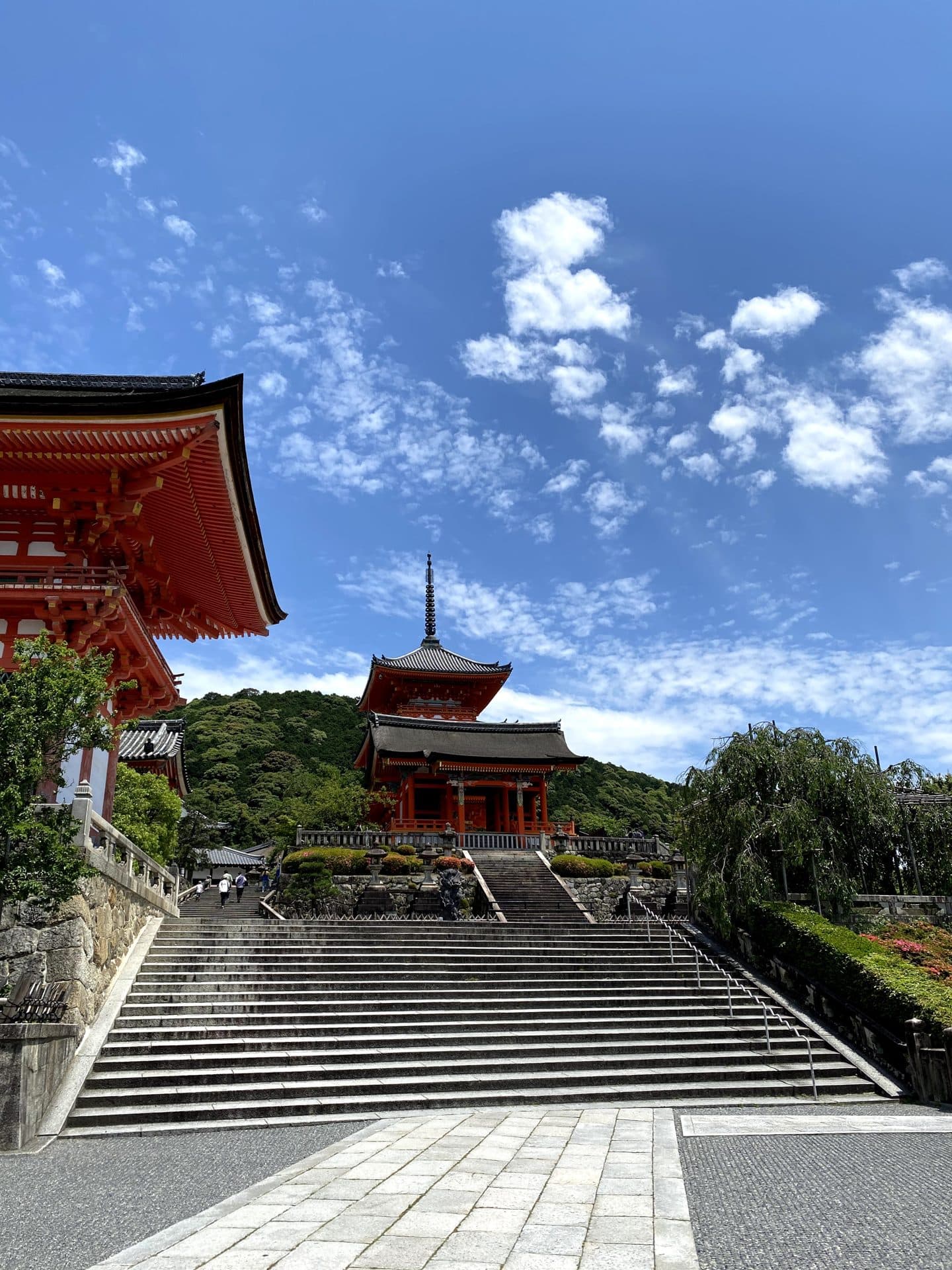
Return to central Kyoto by 9:30am for a proper breakfast (most hotel breakfast service runs until 10am, or pick up an onigiri from the 7-Eleven across the road from virtually any Kyoto hotel). Then head to Arashiyama via the Sagano line from Kyoto Station (25 minutes, ¥240 on Suica). The bamboo grove is free and open around the clock — arrive before 10am for passable shots. Immediately behind the bamboo grove, Tenryu-ji is a 14th-century Zen temple with a garden designed to "borrow" the mountain scenery behind it (¥500, 8:30am–5pm). Worth 30 minutes.
Optional afternoon add: Kinkaku-ji (the Golden Pavilion, ¥500) is 20–25 minutes from Arashiyama by taxi. Its gold-leaf exterior reflected on the mirror pond is one of the most reliably stunning sights in Japan — but expect a 30–40 minute entry queue on busy days. If the queue doesn't bother you, add it. If you'd rather walk at Arashiyama's pace, leave Kinkaku-ji for another trip. A good substitute for this afternoon: a matcha tea experience in a Kyoto tea house — the ritual is uniquely Kyoto and takes only 45 minutes.
Day 5 — Final Morning in Kyoto, Then Departure
Your available time depends on your flight. For an afternoon flight from Kansai International (KIX) or Itami (ITM): you have a free morning — use it for Nijo Castle (¥1,000, opens 8:45am), a 17th-century shogun's fortress with elaborate painted interiors and "nightingale floors" engineered to squeak underfoot as an intruder alarm. It's on every Kyoto UNESCO list for good reason, and unlike most Kyoto sites it's easy to absorb in 60–75 minutes. Alternatively, if you're visiting in spring or autumn and can walk for an hour, the Philosopher's Path (free, along a canal lined with cherry or maple trees depending on season) is a genuinely peaceful finish to a busy trip.
Airport logistics (as of 2026-05): From Kyoto to KIX, the Haruka Airport Express departs Kyoto Station directly (75 minutes, ¥3,640 unreserved or ¥4,150 reserved). From Kyoto to Osaka Itami (ITM), the airport limousine bus runs from Kyoto Station (55–70 minutes, ¥1,340). If you're returning to Tokyo for a Narita departure, the shinkansen back to Tokyo Station plus the Narita Express is 4–4.5 hours gate to gate — build in buffer. Allow at least 3 hours before your international flight at any of these airports.
Practical Logistics at a Glance
| What you need to know | |
|---|---|
| IC card | Get a Suica at Narita or Haneda on arrival. Works for all trains, subways, buses, and convenience stores in both cities. |
| Tokyo → Kyoto | Nozomi shinkansen: 2h15min, ¥14,170 reserved (D/E seat = Fuji view). Hikari: 2h40min, ¥13,850. Book ahead on peak dates. |
| Tokyo base | Shinjuku and Asakusa both work. Shinjuku has more nightlife and the airport express. Asakusa has walkable temple access. |
| Kyoto base | Kawaramachi/Gion for walking access to Ninenzaka, Gion, and day-trip bus routes. Station area for maximum transport convenience. |
| Cash | Some small restaurants and shrines are still cash-only. 7-Eleven, Japan Post, and Lawson ATMs accept foreign cards nationwide. |
| Language | Google Maps works perfectly in both cities. Translate app with camera mode reads menus and signs. Most hotel staff speak workable English. |
Frequently Asked Questions
Is 5 days really enough for both Tokyo and Kyoto?
For a first visit, yes — with one condition: don't add more cities. Two full days in Tokyo and two full days in Kyoto is enough to go beyond surface-level sightseeing in each. Trying to add Osaka, Nara, or Hakone turns the trip into a schedule-management exercise. Cut those for a second trip.
Should I do a Nara day trip from Kyoto?
Only if you've already seen Fushimi Inari, Arashiyama, and at least one Kyoto temple — and you have half a free day. Nara's deer park is memorable, but it's 45 minutes each way from Kyoto, which expands a 'quick morning' into a full transit day. On a 5-day trip, Nara is a cut.
Which airport arrangement saves the most time?
Fly into Tokyo (Narita or Haneda) and depart from Osaka (Kansai International or Itami) — an 'open-jaw' booking. This eliminates the backtrack shinkansen to your arrival city and is usually equal in price or cheaper when booked through major carriers. Check both routing options when searching flights.
What's the best time of year for this itinerary?
April (cherry blossom, first two weeks) and November (autumn foliage, mid-month) are peak season — stunning but crowded and expensive. For fewer people with still-good weather: mid-May, late September, or early October. Summer (July–August) is hot, humid, and busy. January–February is cold but has the lowest hotel prices of the year.
Where should I stay in Kyoto — near the station or near Gion?
Near the station if you value transport convenience (fast airport access, easy shinkansen boarding, JR/subway hub). Near Gion or Kawaramachi if you value walkability to temples and the evening atmosphere of the historic district. Both areas have every price point from budget hostels to traditional ryokan.


